Too Intense? Part II. · 26 October 2008

Someone asked if there's a magic bullet that’ll resolve the contradictions we generated on this topic. Maybe I could argue it's the red thread of kundalini...? Alas, sorry. :)

There is a refinement within and radiating from the body some old practitioners—I won’t try to deny that. And I can’t say what it’s about.

For what is at stake here, though, I think there is an elegant principle that resolves most of the antinomies. I usually hesitate to go integral, because the first layer of the theory (the fourfold table) is nothing but a compass with no intrinsic explanatory power; and the second layer (the map of the evolution of human consciousness) tends to either piss people off or reduce everything to evolutionary pissing contests. So I’ll ignore the second layer. But… the parsimonious, four-cornered map does organize the different kinds of concerns everyone raised about the prospects of this intense physical-psycho-emotional-whatever program. According to this map, every "moment" of existence (for example, me here now = a moment) can be seen from four angles at once. Inside and outside, collective and individual.


1. Inside-Individual

(psyche, subtle body)


2. Outside-Individual

(behavior, gross body);


3. Inside-Collective

(Culture, shared values)


4. Outside-Collective

(social structure: class, ethnicity, nationality, gender)

It’s not as obnoxious as it looks, I swear. When you hit a conundrum with the integral light saber, it explodes it into four. Who knows if this makes things more tractable or multiply more complex.

Is this bizarre practice suitable for a person: 1. Can the individual body hack it? 2. What about the individual psyche? 3. What are the shared cultural limitations and implications? 4. Is it possible and good within whatever social organization?

One, about the body (the exterior of the individual), sounds like a conditional yes. As V said, body type matters, and there are a lot of factors this comprises.

Question two, about the psyche is maybe more interesting. This practice is so intense! It forces a person into even more intimate contact with weird parts of her psyche and forces her to either make peace with them or “vomit them out” in service of an obsession. Sonya mentioned she’d seen people do this practice and be warped, sadly, into selfish jerks; Holden’s heard these rumors of the 3S programme leading to the vomiting of shadow elements… anyone else have a worst case scenario on a psycho-emotional dimension? Maybe Gopi Krishna isn’t so out of bounds after all. :)

Is all this just myth and mystification? The only generalization I’m comfortable making is that even the most neurotic, selfish 3S practitioners—the ones who maybe have been internally disfigured, though that is for their teachers, hopefully, to see—know their own minds very well. Better than most. The common allegation that advanced ashtanga creates bipolarism intrigues me: have these so-called ashtanga victims been unmasked by a truth-telling process or simply traumatized by their own poorly-chosen practice/teacher?

Maybe I should be open—later—about what that process has been like for me. For several kind of complicated reasons. I’m amusing the shit out of myself lately, moving through paradoxes of obsession/dedication, shadows/love. Something old Mr. MW has given me recently, in his deconstruction of my practice, is the criticism that ashtanga is hopelessly, blindly obsessive. To the point of generating collective body dysmorphia and chemical addiction. Rather than pissing me off or making me want to reject his teaching, this criticism endeared me to him and freed me to see the insanity in what we do. I’m not on a mission to prove him wrong, but I would like to circumscribe the cases in which he’s right and chart a way through this tradition that acknowledges the depth and truth of my own experience.

The third point of view, about what is shared but subjective, is I think what has made this conversation so tense. When it comes to beliefs about womanhood and what is socially appropriate, we carry feelings that seem so personal but are the more powerful because they’re culturally received and because we see them reflected in others. There is a pressure to reproduce the shared ideas… or a pugnacious urge to subvert them. Mircea Eliade wrote beautifully if perhaps unreliably about yoga as a deconditioning process—both of an individual’s hangups and of his [sic] cultural baggage.

People in this particular orbit seem to agree that a powerful, quasi-traditional, shamanic, contortionist breathing and meditation practice—while uniquely absurd in our context—creates women in a good way. Maybe even a very good way. The openness, independence, groundedness, self-awareness, bravery and strength of this programme may conflict with old school ideas about weak, soft, receptive feminity that "belongs in the home" because men's responsibility and because the owned female body should not be seen. But the residual tension of the last few generations’ problematic ideas about womanhood are part of what makes this practice vital. It is a very good challenge: to see what was good, beautiful and true in the old female archetype and carry that forward without being caught up in reactivity (as if we ever de-condition ourselves of culture altogether). The new culture that this practice creates around femininity—is there a degree of liberation in it? I would say, very often, this is so.

The fourth perspective is social context. Ashtanga is almost a hopelessly Brahmin activity—in the west as well as the east. Its first 1.5 generations were also hopelessly patriarchal and light-complected, as at least a good number of readers agree.

But yoga, once it becomes a lifestyle, manifests this counter-trend of quasi-freeloading authorized and certified teachers unencumbered by material things, who justify their bohemianism (sweetly, if deconstructably) with a glance to the cell-phone saddhus of the east. This is hippie-renunciant-ism, and insofar as this kind of yoga garlands the enormously privileged subculture of ashtanga, it keeps things interesting and a little more honest. There are, as a result, two cultures within ashtanga itself—the diamond-studded gold-chained householders with professional degrees and property, and the people who have given everything to the practice, and ironically carry on their lithe bodies a special contortionism-capital (kapotal, it's been called) to which the propertied folks pay respect. (The coming global slowdown will, I think, bring these two strands within ashtanga closer together….)

But I’m getting distracted. I think the social-structural perspective on women doing advanced practice has to consider both social class (for what women is this feasible, energetically, if they also have modern social responsibilities?) and this notion of staying fecund for the tribe. Can the social organization of the world we’re living in cope with women doing this shit—on a practical level? Does the change in women’s work, and potential for authority, and capacity for élan actually benefit us all when women start emerging as practical masters of psychological, physical or even spiritual practice? Do we need women taking it to the edge? Yeah, I think so. Actually, maybe this is the best argument for women who have the time, opportunity, and a certain physicality and the mental stability to take it to that level if they’re so inclined. I hadn’t really thought about it before, but it is funny to take a ridiculously elitist practice and reveal—over the course of just one generation—that being a woman, and being poor, actually can increase the likelihood of at least physical “mastery.” Is that trivial? I don’t think so.

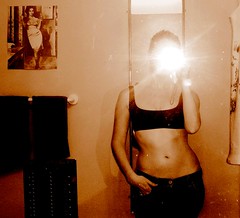
Here’s my shoulders and me, looking at myself, against the background of Butterfield 8 Liz Taylor as a sacrificial, transitional woman under some man's objectifying gaze. (Admittedly, I am grateful enough for what she represents to pin her up in my bathroom.) Things change—a few decades is a long time when cultural and cellular exchange becomes as highly entropic as it is now. Apologies if my navel is TMI for you—that’s just your boundaries talking, pre-entropy. :)

Two women

Posted by (0v0)        
Categories: astanga yoga , esoteric shit , evolution , having a body , markets-networks-society , morality

Previous entry:    /   Next entry:

Comment

  1. well, i’d hit it.

    Posted by: meniscusmerangue · Oct 27, 01:14 AM · #

  2. but that aside, a few other immediate responses:

    based on the small sample available to me, yes, the more advanced the physical practice, the nuttier the practitioner but those who have stuck with it for 25-30 yrs+ seem have turned out alright, irrespective of body type/sex. Long time spinal hide and seek. When there’s nowhere left to hide, why even try, sushumna-sigh?

    myth brahmanas, homogeny/androgeny:
    here we are, back to the minoan bull jumpers.
    The seen exists for the benefit of the seer? Well, the old fellas benefit quite a bit from all this gender-melded lissomness – it’s a sort of ‘liberation’ (so i’m told, phaedrus). But then it’s also out of the bag for the rest of us, too.

    Yes, perhaps we do need (some) women to take it to that level, more so now than in the time before sociology was conjoured up. Might even represent a sort of conclusion to that particular cycle. Plus, it would be handy to have people about who could exorcise the ghost of gender studies should it go on a-haunting too long in a body’s life.

    No need to stand on ceremony, blog-boss. If the internal/external conditions are right, go with it.

    Posted by: meniscusmerangue · Oct 27, 02:05 AM · #

  3. That photo’s brilliant!

    Fascinating, this:

    “There are, as a result, two cultures within ashtanga itself—the diamond-studded gold-chained householders with professional degrees and property, and the people who have given everything to the practice, and ironically carry on their lithe bodies a special contortionism-capital (kapotal, it’s been called) to which the propertied folks pay respect. (The coming global slowdown will, I think, bring these two strands within ashtanga closer together….)

    ...But I’m getting distracted.”

    Very interesting.

    It seems to be my m.o., though, to get most interested in the little side-discussion that distracts or detracts from the part which is supposed to be the point. :) I’m myopic when it comes to all this mostly because it’s only in the micro, in the personal and physical experience of advanced asana that I see much to chew on.

    I really do think it’s all, mostly, a non-issue. I believe that most of us, those for whom ashtanga is a lifestyle or an obsession, will certainly do what we want to do/can do, physically. (It’ll be different for all of us, depending on lots of factors.) And I’ve always thought that women have the ‘hand’ in this practice. We’re here, we’re bendy, we’re strong enough, obv. The younger generation of ashtanga and power-yoga ‘celebrities’ counts several high-profile women. Are there actually any stats on 3S? How many women are practicing it in Mysore at a given time? I would be surprised to learn if there were fewer XX than XY in the .5 generation.

    Posted by: joy · Oct 27, 04:46 AM · #

  4. Your shoulders look the same to me, but your abs look fantastic!!!! :)

    Posted by: LI Ashtangini · Oct 27, 05:17 AM · #

  5. First off, I need to reread this later, because the initial read went like this:

    “It’s not as obnoxious as it looks, I swear.”
    Howling

    “Kapotal, it’s been called”
    Double Howling

    “I’d hit it” (first comment)
    Yet More Howling Ensues

    So this is one of the funniest things I’ve ever seen you write here, congrats.

    Also, yes, no boulder shoulders on you, but totally Ashtanga Abs, if you will. I participated in no omphaloskepsis, at least none yet.

    My inclination is that long term exposure to Ashtanga yoga does promote some degree of nuttiness, the way it’s been discussed elsewhere that practitioners tend to get more “conservative” and then, as they “crest” or “see the light” or whatever, they mellow out. This, apparently, has been, for example, Tim Miller’s trajectory (teachingwise anyway).

    I know, for certain, that if the job market brings me regular exposure to a Mysore-style room, I am going to get much more obsessive than I am now, and I’m pretty freakin’ obsessed. Oddly, I’m not quite sure WHY I’m obsessed, and that’s a big chewy question.

    Good stuff here, well done.

    Posted by: patrick · Oct 27, 06:00 AM · #

  6. Hi, thanks for all these good thoughts. Is the end of gender studies really in sight now? Oh thank god. Patrick, if you came to my class I'd be obligated to be strict with you and we'd both find this hilarious. And useful.

    Just briefly, Liz sent over this amazing interview with Saraswathi.

    A few lines: I think for most of the women who work a lot and then take care of their homes and their families it is enough to do Primary series. After having a regular practice for a long time they can do Intermediate as well. Some women can do advanced as well but I don’t think that is so necessary. Primary makes us grounded and strong!

    At a glance, I disagree with most of what she says. But that is because she and others like her have created the economic and cultural space for me to see it another way. Talk about a transitional figure. I’ve only met her a few times but she’s sort of awesome, esp because kind of difficult. I express my adoration and admiration in contrareity. I wonder if my energy toward the interview content would be different if the words were from a man? Maybe I shouldn’t differentiate so much in my heart. Anwyway, distracted again… :)

    Back to the matter at hand! (I too love the interstices, JS…) l8r—

    Posted by: (0v0) · Oct 27, 09:37 AM · #

  7. Oh and JS, I have a feeling you will hit it. I’d love to see that, I have to admit.

    Posted by: (0v0) · Oct 27, 09:41 AM · #

  8. But she might have a point, you know. Not everyone can do everything. I am always wary of the myth of the superwoman. Why is there such a negative connotation to doing less by choice? Overachieving in all areas of our lives is a tall order.

    Posted by: V · Oct 27, 11:28 AM · #

  9. wohoo. i’m on my lunch hour trying to digest the intellectual stuff and come to the picture. my brain went away. i will have to come back later and digest your philosophicals musings and not get distracted.
    hugs
    Arturo

    Posted by: arturo · Oct 27, 11:37 AM · #

  10. it’s bookworthy. contortionist shamanic breathing? i love your word constructs. what does being poor and being a woman have to do with mastery of yoga? I have to howl with Patrick at some of your ideas, but they are brilliant.
    hugs
    Arturo

    Posted by: arturo · Oct 27, 04:44 PM · #

  11. I love the photo. I love the Elizabeth Taylor pic (it’s on my fridge!!)- and how your body posture mimics it. What I like best, though, is how your head is just a big, bright flash of light. It’s like “my mind is what really shines, but there is a body attached…” You think a lot more about this stuff than I do. It’s fun to read. Shine on, Owl!

    Posted by: Liz · Oct 27, 05:05 PM · #

  12. so, ovo, what’s your point with this women’s bodies and dysmorphia and neuro eroticism – all comingling as advanced ashtanga practice. taking us to new heights of wisdom and domination over our yet to be perceived reality. this yoga, like any other yoga, is what we choose it to be. a noose for subjugating ourselves to some notion of who we are or might someday be, or a path to freeing the mind of bs.

    Posted by: charusheela · Oct 27, 05:05 PM · #

  13. Yes, maybe I make too much of it—both options are present regardless of these modern notions about gender and class and sport. What’s that line from Mohan someone quoted in the ‘sphere?...

    The mind posesses extraordinary powers of creation and imagination that can lead us either into feedom or bondage.

    But I always wonder if this is secret knowledge. If bondage, lovelessness, fear, shallowness… if they seem like a natural state and not a chosen one. You pierce right through to the mind so easily Charu, as if you were born to breathe.

    Posted by: (0v0) · Oct 27, 05:27 PM · #

  14. Liz, you have that pinup on your fridge?? And you love documentaries about debonair 70s-era scientists and forgotten abstract painters, read scary books in October, have a habit of gravitating toward asylums, and harbor a kind of serious long-term Chuck Norris fetish?

    I don’t think there’s a subcultural meme that explains this smorgasboard of our common oddities. Someone, call a psychic.

    Posted by: (0v0) · Oct 27, 05:29 PM · #

  15. Well if I can get you howling even on the darkest moon tonight, my dear funny Arturo, I am delighted. I asked my teacher this morning if I’m crazier of late and he said he can’t tell because he’s too damn crazy himself. What do you do? I wonder if we all may be losing it.

    Lovely thought.

    Posted by: (0v0) · Oct 27, 05:30 PM · #

  16. Meantime, amid administrivia, I thought all day of lissome lyceum. Lissome lyseum lysome lyseum lissome salome lysol. Lyceum. (Also, administrivia ad astra, I keep chanting Gil Scott Heron under my breath “…and whitey’s on the moon…” It’s not the Jesus Prayer or Vande Gurunam but it sets a nice rhythm. And, after all, whiteys and moons seem of the moment).

    You wanted to make to make me think of Lyceum, Socratito? Well that’s what I did today.

    That’s a very good model for ashtangi community! Esp since the first Lyceum was an Apollonian temple, and this practice—admittedly—veers toward Apollo and away from Dionysus. (Also, Lyceum is an open-source blogging software. Niiiice.)

    So the lyceum was an old meeting place for students. Nevermind this “shala” thing and its manufactured history—the playful anti-authoritarian Greek model has a good 500 years on even Jesus. Pretty legit. I don’t know how much the bohemian Phaedrus-Aristotle student-teacher model related to that, but let’s pretend it did until the classicist around here breaks me for manufacturing history too. What I love about that ancient model of student-teacher is that it was full of creative energy and off-color jokes. And power inversion, with teachers taking refuge in student roles, and students appointed as guest lecturers on a whim. The creative energy was no trouble if got so intense as to turn sexual at the edges—in any case it turned back again always away from sex scandal and to the root of those flashes: SELF-consummation.

    Omphaloskephically. They talked about chastity in a way that may map on to tapas. Maybe the chaste tree even would make more sense here in the west, since there’s a lightness and grin in it, and it’s a place where questions lead to knowledge instead of guilt and beatings with the yoga stick.

    Reminds me of all the discussion here about creative energy last winter and spring. What’s the word we were using for energy-alchemy then? Not transubstantiation… um mental block… lissome lyceum vande gurunam and whitey’s on the moon.

    It has been a long day. xoxovo

    Posted by: (0v0) · Oct 27, 05:38 PM · #

  17. Gotta say that a certain woman practicing 3rd/4th series recently arrived on the scene here, and I am intrigued and inspired.

    Posted by: jlafitte · Oct 27, 05:50 PM · #

  18. Yes, K is amazing, open, and gets a lot done in the world. Glad she has found community with you. New Orleans’ fortunes are shoring up now.

    Posted by: (0v0) · Oct 27, 05:54 PM · #

  19. Indeed.

    Owl, I am amiss in not keeping up with your blog.

    Posted by: jlafitte · Oct 27, 06:07 PM · #

  20. I KNEW I could not trip you up with my all-time favorite multisyllabic word.

    Posted by: patrick · Oct 27, 06:27 PM · #

  21. yes, call the psychics… I think we’d be trouble together. (and, E.T. IS on my fridge! What a bombshell)

    Posted by: Liz · Oct 27, 06:50 PM · #

  22. Liz, I almost went to grad school in Austin. But there was a last-minute counter-offer here. Still, tex-mex and nostalgia for LBJ were selling points.

    Patrick, I guess omphalo from “el ombligo del mundo,” which is what they used to call Macchu Pichu. Omphalo…ombligo…umbilical. Otherwise would have had to google for it.

    Omphalo sounds like a giant, hairy, extremely circumspect Sesame Street puppet based on a plains state equine. Better than lame Tickle Me Elmo. The omphalo could be our team mascot if Sharath hadn’t already tagged us one.

    Posted by: (0v0) · Oct 27, 06:58 PM · #

  23. My favourite posts of yours are so ofton hidden away in your comments sections. The one above on the Lyceum delights me,(still giggling away to myself). Yes VERY Apollonian and yet the Dionysian does seem to come out when you watch how varied everyones practice is in say Youtube Vids, the different Rhythms, the little flourishes here and there. And of course the ekstasis we hear about your Kappotasana ,for example. Been trying to do the old platonic trick of finding a convincing argument for the oppsition, ie woman can’t do 3rd but really can’t think of one. Keep getting drawn though to the question of Authority floating around in the background of your post and the comments. Where it comes from, how it originates and is sustained. imposed or given…sought? And why the need to seek it etc. Really look forward to your posts now, highlight of my week.

    Posted by: grimmly · Oct 27, 11:23 PM · #

  24. Here’s a question for anyone interested: am I wrong to feel more for karna than for arjuna?

    Digging a little… can the celto-germanicans ever really trust the grecosindhicate?

    Perhaps we are/were right (way back) and the overthunkers are just jealous.

    Posted by: meniscusmerangue · Oct 28, 02:26 AM · #

  25. I didn’t know they used to call Macchu Pichu that; speaks to its presence in the culture. BTW, last night I copped from your SUPV notes from some time ago and landed that pose on one side in a sort of “ashtanga playground” class. That bit about “the Precious” was totally key.

    And, a simple but maybe complicated q: do YOU think you should be doing 3S? Or is “thinking you should” not even part of the actual question? Seems to me that someone put “thinking you should” into the discussion back in your Primary and, in a way, set off this whole thread.

    Posted by: patrick · Oct 28, 06:57 AM · #

  26. About body morphology and suitability for 3rd series… having the opportunity to observe M and K on a regular basis, I can say that they just about define the gamut of curvy-stringy, and they both have a strong and fluent practice. What they also have in common is great willpower, focus, tapas, whatever you want to call it.

    Interesting note: a few weeks ago we were talking with M about Mysore. With Guruji effectively in retirement, M said she doesn’t much feel compelled to get more asanas. She expressed interest in learning from Saraswathi, whose practice goes well beyond asana in M’s opinion.

    Posted by: jlafitte · Oct 28, 08:20 AM · #

  27. Hi again (0v0)
    Lafitte, by K I imagine you mean the beautiful K that Alfia photographed recently doing some of 3rd while she was visiting DC.
    Cheers,
    Arturo

    Posted by: arturo · Oct 28, 11:07 AM · #

  28. Now that’s a good ad for yoga!

    Posted by: cody · Oct 28, 11:56 AM · #

  29. Yes Arturo, the same. Actually she had an academic post in DC, from what she told me.

    Posted by: jlafitte · Oct 28, 02:15 PM · #

  30. Karen’s amazing! She is my Yoga Idol.

    Posted by: boodiba · Oct 29, 04:27 PM · #

  31. Well Boodi, perhaps you would like to join our private sessions with M. You can meet your idol.

    Posted by: jlafitte · Oct 29, 05:25 PM · #

  32. Oh good Cesar’s ghost. Criminy. Puckey. Phhht. I leave for a day and it progressively turns into Ashtanga TMZ in here. Talk about entropy.

    Well, I asked for it.

    As for self-doubt, the funny thing is that no. I have no question that I am piecing the right question together for myself and following on that the stitching together of a life that answers them: I don’t question the questions. :) This programme is one of the best tools I have found, and I love it. I don’t always let on the joy and natural wholeness of it because I feel like a blissed pollyanna talking about these things. What I question is the very real current within the culture that says women’s role is something different. I’ve been toying with patriarchy in different ways, ever since someone who knows told me this practice is hopelessly patriarchial and obsessive. To understand the partial truth in that and how it interacts with a lot of personal ashtanga practices that are neither.

    MNSCSMRNG: You second guess the grecosiddhis but not mahabharaht?

    You are not wrong to feel as you do, though. Arjuna is a little too… I don’t know. The idea of karma, and karma yoga, seems to be more complete in Karna. Somehow his character seems more at peace because his conflicts and complications are internal to his life-story. Oh, I don’t know though. All that really makes sense to me are Shakespeare and Steven Colbert, maybe some Spinoza, Diogenes and Marx. More Karna than Krishna, all of em.

    Grimm, that’s sweet. I guess your Martin H. is on my shoulder more than I realize, too, so it’s especially cool to know you come around. I’ll try to stay true. I don’t know to what degree we are ruled by the desire to find a daddy figure for something as trivial as whether the palms should be in or out in Prasarita Paddotonasana C. But I think a lot of us have at least come into very close contact with that desire to have an external, all-knowing teacher. Even the most freespirited among us. :)

    Long day here. It’s already 10:45, late for a Wednesday when Thursday starts soon.

    Posted by: (0v0) · Oct 29, 09:45 PM · #

  33. oVo
    Im conflating the two, hence “grecosindhicate°. Geographically, sindh is near enough, and hrappan heim to boot.

    Now, ok, Karna was a bit off with draupadi, but he is perhaps a better model than that sneak, arjuna. Toy with patriarchy too long professor and it starts to toy with you.

    Pad C : Should you be in a position to choose, then the choice is irrelevant.

    Posted by: meniscusmerangue · Oct 30, 01:23 AM · #

  34. Heh… yeah in the Gita where they’re going on about karma and all, the Marxist in me doesn’t really go for that. Krishna says he chooses to work, and what a nice thing to have it be a choice.

    Rereading my earlier comment, I see the omission of another important attribute K and M share, which is a very, very peaceful demeanor. One time I watched M trying to get into Sayanasana. Kick up, not quite balance, drop down. Over and over with the same graceful effort, not the least hint of frustration or discomfit.

    Posted by: jlafitte · Oct 30, 07:09 AM · #

  35. Oh yeah, patriarchy. Funny when I can’t quite put my finger on it. God.

    Maybe the gestalt is balancing “parampara” and deconstruction, in both practice and the classics. Admittedly, I’d be bored without the latter.

    BTW, Apollo meets Rg Veda.

    Posted by: (0v0) · Oct 30, 08:34 AM · #

  36. then get a proper job. One suitable for a woman.

    Posted by: meniscusmerangue · Oct 30, 10:56 AM · #

  37. I have Cindy Sherman in my bathroom.

    Posted by: katie · Oct 30, 01:18 PM · #

  38. Gauguin’s Seed of the Aroeis graces my bath. Closet patriarchy I suppose.

    Posted by: jlafitte · Oct 30, 05:14 PM · #

  39. I’ll show you proper.

    Posted by: (0v0) · Oct 31, 10:46 AM · #

  40. Owls are predators, no?

    Posted by: jlafitte · Oct 31, 02:05 PM · #

Commenting is closed for this article.

Recently

Paydirt
9 March 2010

Nadi Shodanites
2 March 2010

Offswitches
23 February 2010

Around II
12 February 2010

Embodied knowledge
3 February 2010

Orbit

All Orbits

Flickring

Search